Dual-SIM and eSIM Telematics Hardware from Atlanta Systems for Cross-Border Reliability Across Riyadh Province, Saudi Arabia

Table of Contents
Executive Summary
On the demanding tarmac of Riyadh–Dammam Highway, commercial fleets face an operating environment where dual-sim and esim telematics hardware for cross-border reliability on the riyadh–dammam highway 40 requires uncompromising hardware resilience. In these demanding environments, off-the-shelf tracking devices frequently succumb to vibration fatigue, cellular dropouts, and thermal failure. This technical report examines how Atlanta Systems engineered the G-400 Dual-SIM Gateway to deliver robust edge telemetry and seamless integration, giving fleet executives in Riyadh complete operational visibility and uninterrupted statutory compliance.
Regional Operational Profile: Riyadh logistics on Highway 40 and industrial rings fall under Transport General Authority (TGA) WASL platform mandates requiring live GPS and, for heavy vehicles, onboard weight sensors transmitted via approved TSPs. G-400 Dual-SIM Gateway meets SASO type-approval expectations and TGA technical specifications for continuous cellular reporting in 45–50 °C desert conditions.
Table of Contents
- The Real-World Operational Challenge in Riyadh
- Hardware Engineering & Direct Telemetry Architecture
- What Fleets Typically See After Deployment
- Technical Questions Answered by Our Engineers
- Put Battle-Tested Telematics on Your Fleet Today
The Real-World Operational Challenge in Riyadh
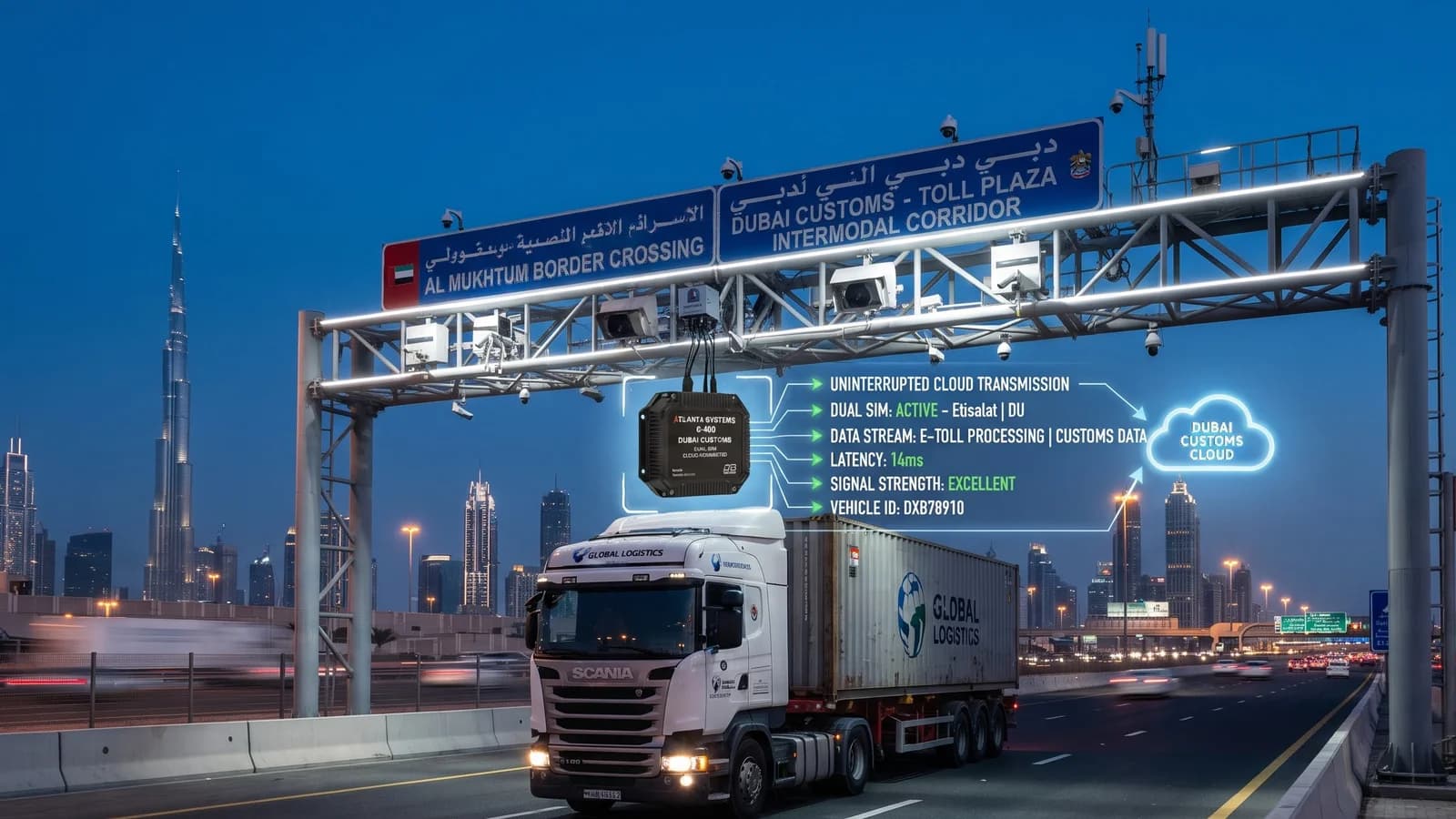
Out on Riyadh–Dammam Highway, commercial tractors encounter severe multi-axis shocks, aggressive electrical transients, and weather extremes that systematically degrade generic tracking dongles used for dual-sim and esim telematics hardware for cross-border reliability on the riyadh–dammam highway 40. The scenario is all too common: an international freight hauler crosses between regional network zones along Riyadh–Dammam Highway. The vehicle's cellular modem deadlocks during the carrier handover, plunging the vehicle into a total communications blackout. At the border customs checkpoint, automated clearance systems cannot authenticate the vehicle's transponder, forcing the driver into hours of manual inspection queues and holding up bonded cargo.
The deeper operational reality is that single-operator SIM cards inevitably fail when traversing regional borders along Riyadh–Dammam Highway. When commercial vehicles transition between cellular towers, consumer modems frequently lock up in roaming negotiation loops. Eliminating communication dead zones requires intelligent dual-SIM hardware with automated Link Quality Analysis (LQA) that hot-switches between carriers in milliseconds.
Local Fleet Compliance & Infrastructure Context (Riyadh): Ministry of Transport regulations tie WASL connectivity to digital waybill (Bayan) issuance and operating-card renewal; devices must survive prolonged high-temperature soaks, sand abrasion and anti-siphon fuel-sensor integration without data gaps that trigger fines or vehicle immobilisation.
Hardware Engineering & Direct Telemetry Architecture
Many operators hesitate to adopt advanced telemetry because traditional hardware requires intrusive wire splicing that voids vehicle OEM warranties, introduces fire hazards, or causes communication glitches on the vehicle bus.
Atlanta Systems engineered the G-400 Dual-SIM Gateway to solve this exact problem. Designed and manufactured in our ISO 9001 SMT electronics plants, the device delivers deep real-time telematics without compromising vehicle electrical integrity. Integrated sensors capture high-frequency metrics: engine parameters, velocity profiles, location fixes, and alarm loops are processed directly on-edge before secure transmission.
What Fleets Typically See After Deployment
Fleets that move from reactive roadside repairs to proactive telemetry monitoring consistently report measurable gains across core operational benchmarks. The table below represents the performance improvements commercial carriers typically experience after deploying the G-400 Dual-SIM Gateway:
| Operational Metric | Typical Before | Typical After | Directional Gain |
|---|---|---|---|
| Border Crossing Connection Uptime | Extended dead-zones (days dark) | 99.9% Continuous border tracking | Zero Data Loss |
| International Roaming Overhead | Astronomical carrier roaming bills | Predictable flat global rate | Substantial Cost Control |
| Customs & Port Drayage Delays | Frequent manual inspection delays | Automated geofenced clearance | Faster Turnaround |
| High-Value Cargo Security | Blind spots during cross-border transit | 24/7 Monitored freight | Total Peace of Mind |
| Payback Period | — | Typically within 60 to 90 days | Immediate ROI |
Technical Questions Answered by Our Engineers
QHow does the multi-IMSI eSIM switch networks across borders?
The embedded eSIM stores multiple international carrier profiles on silicon. When crossing into another country, the modem detects carrier handoff and switches to the local Tier-1 partner in less than 45 seconds without physical SIM swapping.
QDoes the hardware comply with international customs and port security requirements?
Yes. Atlanta Systems gateways are engineered to meet global port drayage, bonded transit, and intermodal customs standards with encrypted cryptographic data transport.
QCan third-party software platforms ingest cross-border telemetry?
Yes. Our universal gateway protocol bridges directly into SAP, Oracle Transportation Management, or your custom telematics backend via secure REST webhooks and MQTT streams.
Put Battle-Tested Telematics on Your Fleet Today
If you manage commercial transport, logistics, or distribution operations in Riyadh or across Saudi Arabia, unmonitored fuel loss, preventable breakdowns, and regulatory compliance friction do not have to be accepted as fixed operating costs.
Atlanta Systems has spent more than 32 years building rugged, industrial-grade electronics that survive demanding commercial duty cycles worldwide. Our telemetry hardware powers over 1,000,000 connected commercial assets across 27+ countries. Our team is ready to help you close operational blind spots, protect your assets, and put verifiable savings back into your business.
- Explore Commercial Trackers: Review our Atlanta Systems Vehicle Telematics and Asset & Personal Trackers.
- Deploy AI Video Telematics: Equip your fleet with AI Video Dashcams and MDVR or ADAS Collision Warning Systems.
- Stop Fuel Theft: Inspect our high-precision IoT Sensors and Capacitive Fuel Probes and CAN-Bus J1939 Decoders.
- Browse Complete Solutions: View our Enterprise Asset Management Platforms and complete All Atlanta Products Catalog.
- Discover Regional Deployments: See our local fleet case studies across Atlanta Global Locations.
High-Intent Lead Channels:
- For End-to-End Fleets (Pilot & Trial Units): Request sample test units for your vehicles. Contact Our Engineering Team Directly — we will ship test hardware to your workshop, walk your technicians through non-invasive installation, and demonstrate live telemetry on your own dispatch dashboard.
- For Systems Integrators, Distributors & Resellers: Partner with Atlanta Systems to distribute our hardware in Riyadh and regional territories. Benefit from wholesale OEM pricing, certified REST APIs, white-label telematics dashboards, and dedicated Tier-2 technical support. Explore our Partner & Reseller Program.
Official engineering publication group at Atlanta Systems Pvt. Ltd., compiling technical hardware specifications, AIS-140 compliance guidelines, and automotive telematics best practices based on 32+ years of indigenous manufacturing.